
Promotion of Innovation
It encourages innovation in telecommunication services through regulatory sandboxes and provisions for testing new technologies, fostering research and development in the sector.
What’s New ?
Reach out to us for any queries, support, or further information related to telecom services and policies.
Contact Us
Need Assistance? We’re Here to Help
Reach out to our help desk for support or answers to any queries related to telecom services.
Raise Ticket/Feedback/Suggestions
Your Feedback Helps Us Improve
Submit feedback or suggestions to help us enhance our services.
Associated DoT Nodal Wings
Connect with Our Regional Officers
Find and contact nodal officers for region-specific telecom service assistance.
Vigilance Complaints
complaints, malpractice, corruption etc.
You can report complaints against DoT units Officers
Telecom Services
Telecom Services
Digital Growth
One Portal
Unlimited PossibilitiesGovernment, in 2016, introduced Virtual Network Operators (VNOs) under the regime of Unified License for VNO with the aim to delink the “licensing of…
Government, in 2016, introduced Virtual Network Operators (VNOs) under the regime of Unified License for VNO with the aim to delink the “licensing of…
Captive Mobile Radio Trunking Service (CMRTS) is a telecommunications service designed to provide dedicated mobile communication channels for…
The Department of Telecommunications (DoT), Government of India, issues/renews No Objection Certificates (NOCs) for the sale/rent of International…
PMRTS stands for Public Mobile Radio Trunking Service. It is a mobile communication service designed for public use, particularly in the context of…
Public Mobile Radio Trunking Service (PMRTS) is a two-way mobile communication service that allows multiple users to share a common set of radio…
Equipment Type Approval (ETA) is a certification issued by the Wireless Planning & Coordination (WPC) Wing of the Department of…
Certificate of Proficiency (CoP) is a certification issued by WPC Wing, DoT to individuals who have demonstrated the required knowledge and skills in…
For operation of various Satellite based network (Telecommunication/ Broadcasting) WPC Wing grants frequency assignment to the operators.
A Non-Network License is a regulatory clearance granted for use of communication equipment on vessels and aircrfats without direct integration into a…
Frequency assignment for setting up Terrestrial network is granted by WPC Wing of DoT. Kindly see the list of applications below for relevant…
An Experimental, Manufacturing & Demonstration License is a regulatory clearance granted to entities engaged in research, development, and…
The In-Flight and Maritime Connectivity (IFMC) service is a communication framework established under the Indian Telegraph Act, 1885, to facilitate…
The Infrastructure Providers Category-I are those Infrastructure Providers who provide assets such as Dark Fibre, Right of Way, Duct space and Tower…
The Centralized Right of Way (RoW) Permissions system serves as a collaborative institutional mechanism, uniting all stakeholders, including Central…
Implementing common and shareable telecom ducts and utility corridors in all linear projects, especially by the central/state/UT governments can…
Call Before u Dig (CBuD) is an innovative initiative, developed by Department of Telecommunications (DoT) with help of BISAG-N. CBuD launched by Hon&…
UL- Authorization of AUDIO CONFERENCING/ AUDIOTEX/ VOICE MAIL SERVICES at National Level.
App Providers under PM WANI create and manage mobile applications that connect users to nearby public Wi-Fi networks.
The PDOA license enables entities to manage multiple Public Data Offices, providing public Wi-Fi access through the PM WANI framework.
This sandbox allows companies to test innovative wireless technologies within a controlled regulatory environment.
SARAS (System for Assessment of License Fee Revenue and Spectrum Usage Charges) is an advanced, cloud-based application designed to simplify and…
The Import License permits companies to import wireless communication equipment into India, ensuring regulatory compliance of imported devices.
The DPL (Dealer Possession License) allow entities to possess wireless equipment for business use.
This is a licensing process for migration of existing license to the Unified License (UL) to ensure that UL regime covers all the existing licenses.
M2M communications refer to automated applications which involve machines or devices communicating through a network without human intervention…
Commercial VSAT license allows closed-user groups to establish private communication networks using satellite technology.
National Long Distance (ILD) services licensee can carry telecommunication traffic from one Licensed Service area (LSA) to another LSA. The Licensee…
The Numbering Resource Management System (NRMS) facilitates the allocation of numbering resources like MSC, M2M, Fixed line, LRN, MCC-MNC, Tele…
This authorization is required for entities that intend to offer internet services within India.
Global Mobile Personal Communication by Satellite (GMPCS) Authorisation under UL, authorizes the use of satellite technology (GSO/NGSO) for satellite…
Captive VSAT CUG License allows to install VSAT, i.e. small-sized earth station(s), to provide data connectivity between various sites scattered…
International Long Distance (ILD) service licensee has full flexibility to offer all types of bearer services. The Licensee will provide bearer…
Access Services Licenses are a category of regulatory authorizations granted by Department of Telecommunications to telecom operators. These licenses…
One Portal
Unlimited PossibilitiesGovernment, in 2016, introduced Virtual Network Operators (VNOs) under the regime of Unified License for VNO with the aim to delink the “licensing of…
Government, in 2016, introduced Virtual Network Operators (VNOs) under the regime of Unified License for VNO with the aim to delink the “licensing of…
Captive Mobile Radio Trunking Service (CMRTS) is a telecommunications service designed to provide dedicated mobile communication channels for…
The Department of Telecommunications (DoT), Government of India, issues/renews No Objection Certificates (NOCs) for the sale/rent of International…
PMRTS stands for Public Mobile Radio Trunking Service. It is a mobile communication service designed for public use, particularly in the context of…
Public Mobile Radio Trunking Service (PMRTS) is a two-way mobile communication service that allows multiple users to share a common set of radio…
Equipment Type Approval (ETA) is a certification issued by the Wireless Planning & Coordination (WPC) Wing of the Department of…
Certificate of Proficiency (CoP) is a certification issued by WPC Wing, DoT to individuals who have demonstrated the required knowledge and skills in…
For operation of various Satellite based network (Telecommunication/ Broadcasting) WPC Wing grants frequency assignment to the operators.
A Non-Network License is a regulatory clearance granted for use of communication equipment on vessels and aircrfats without direct integration into a…
Frequency assignment for setting up Terrestrial network is granted by WPC Wing of DoT. Kindly see the list of applications below for relevant…
An Experimental, Manufacturing & Demonstration License is a regulatory clearance granted to entities engaged in research, development, and…
The In-Flight and Maritime Connectivity (IFMC) service is a communication framework established under the Indian Telegraph Act, 1885, to facilitate…
The Infrastructure Providers Category-I are those Infrastructure Providers who provide assets such as Dark Fibre, Right of Way, Duct space and Tower…
The Centralized Right of Way (RoW) Permissions system serves as a collaborative institutional mechanism, uniting all stakeholders, including Central…
Implementing common and shareable telecom ducts and utility corridors in all linear projects, especially by the central/state/UT governments can…
Call Before u Dig (CBuD) is an innovative initiative, developed by Department of Telecommunications (DoT) with help of BISAG-N. CBuD launched by Hon&…
UL- Authorization of AUDIO CONFERENCING/ AUDIOTEX/ VOICE MAIL SERVICES at National Level.
App Providers under PM WANI create and manage mobile applications that connect users to nearby public Wi-Fi networks.
The PDOA license enables entities to manage multiple Public Data Offices, providing public Wi-Fi access through the PM WANI framework.
This sandbox allows companies to test innovative wireless technologies within a controlled regulatory environment.
SARAS (System for Assessment of License Fee Revenue and Spectrum Usage Charges) is an advanced, cloud-based application designed to simplify and…
The Import License permits companies to import wireless communication equipment into India, ensuring regulatory compliance of imported devices.
The DPL (Dealer Possession License) allow entities to possess wireless equipment for business use.
This is a licensing process for migration of existing license to the Unified License (UL) to ensure that UL regime covers all the existing licenses.
M2M communications refer to automated applications which involve machines or devices communicating through a network without human intervention…
Commercial VSAT license allows closed-user groups to establish private communication networks using satellite technology.
National Long Distance (ILD) services licensee can carry telecommunication traffic from one Licensed Service area (LSA) to another LSA. The Licensee…
The Numbering Resource Management System (NRMS) facilitates the allocation of numbering resources like MSC, M2M, Fixed line, LRN, MCC-MNC, Tele…
This authorization is required for entities that intend to offer internet services within India.
Global Mobile Personal Communication by Satellite (GMPCS) Authorisation under UL, authorizes the use of satellite technology (GSO/NGSO) for satellite…
Captive VSAT CUG License allows to install VSAT, i.e. small-sized earth station(s), to provide data connectivity between various sites scattered…
International Long Distance (ILD) service licensee has full flexibility to offer all types of bearer services. The Licensee will provide bearer…
Access Services Licenses are a category of regulatory authorizations granted by Department of Telecommunications to telecom operators. These licenses…
Benefits of
Telecom e-Services Portal
How Telecom e-Services Portal Help You?
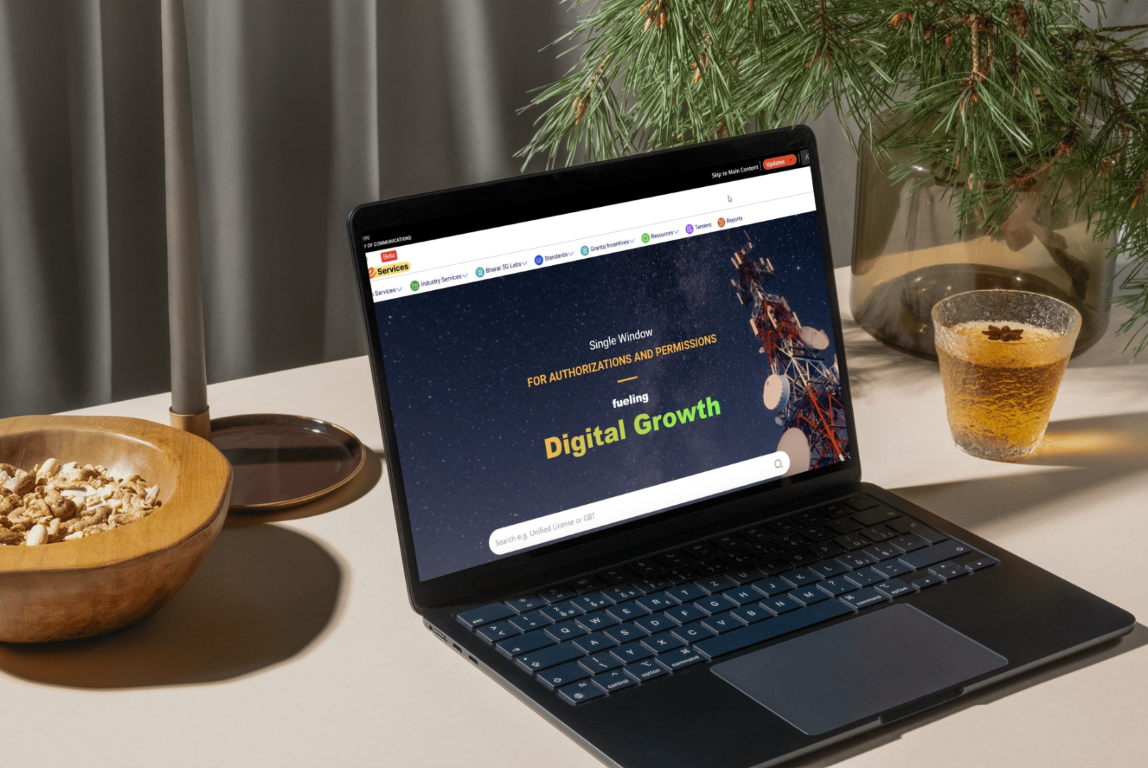
The Department of Telecommunications (DoT) eService Portal consolidates over 20 existing service portals into a comprehensive, centralized platform, enhancing the efficiency and experience for all stakeholders. This integrated approach allows users to access various services through a single point, simplifying navigation and streamlining processes. Automation within the portal supports efficient lifecycle management of licenses, improving productivity and user experience with a unified, consistent interface. Enhanced data integration ensures accurate and easily accessible information, while real-time dashboards provide valuable insights into operations and performance. The platform also supports effective complaint resolution, seamless stakeholder collaboration, and scalability for future services. Additionally, the consolidated portal optimizes resources for cost efficiency and strengthens compliance and data security through standardized processes.
Users access various services through a single point, simplifying navigation.
Automation expedites licensee lifecycle management, boosting efficiency.
A unified interface provides a consistent and user-friendly experience.
Better integration ensures accurate and accessible information.
Dashboards offer real-time insights into operations and performance.
Users can easily raise and track complaints for quick resolution.
Seamless sharing improves coordination among stakeholders.
The platform allows for easy addition of new services.
Users access various services through a single point, simplifying navigation.
Automation expedites licensee lifecycle management, boosting efficiency.
A unified interface provides a consistent and user-friendly experience.
Better integration ensures accurate and accessible information.
Dashboards offer real-time insights into operations and performance.
Users can easily raise and track complaints for quick resolution.
Seamless sharing improves coordination among stakeholders.
The platform allows for easy addition of new services.
Users access various services through a single point, simplifying navigation.
Automation expedites licensee lifecycle management, boosting efficiency.
A unified interface provides a consistent and user-friendly experience.
Better integration ensures accurate and accessible information.
Dashboards offer real-time insights into operations and performance.
Users can easily raise and track complaints for quick resolution.
Seamless sharing improves coordination among stakeholders.
The platform allows for easy addition of new services.
Salient Features
The Telecommunications Act of 2023 introduces several salient features aimed at modernizing and regulating the telecommunication sector in India. Here are the top 10 salient features of the Act
Promotion of Innovation
It encourages innovation in telecommunication services through regulatory sandboxes and provisions for testing new technologies, fostering research and development in the sector.
Emergency Provisions
The Act grants the Central Government the authority to take control of telecommunication services during public emergencies, ensuring priority routing of messages for response and recovery.
Digital Governance
It emphasizes the use of digital platforms for regulatory processes, including online submissions, tracking of service requests, and digital functioning of adjudicating bodies.
Consumer Protection Provisions
The Act includes provisions aimed at protecting consumer rights, promoting fair practices, and ensuring quality of service in the telecommunication sector.
Cybersecurity Measures
Telecom Cyber Security rules, 2024 mandates that no person shall use telecommunication equipment or telecommunication identifier or telecommunication network, or telecommunication services, including through:a. Fraud, cheating or personationb. Transmitting any message which is fraudulentc. Committing or intending to commit any security incidentd. Engaging in any other use which is contrary to any provision of any law for the time being in force.Each telecommunication entity shall ensure compliance with the measures mentioned in Telecom Cyber Security Rules, 2024.
Adjudication Process
The Act introduces a formal adjudication process for resolving disputes and contraventions, appointing Adjudicating Officers and Designated Appeals Committees to handle inquiries and appeals.
Regulatory Authority
It empowers the Telecom Regulatory Authority of India (TRAI) to set standards, assess conformity, and regulate telecommunication services, ensuring compliance with safety and quality measures.
Spectrum Management
The Act outlines a structured process for the assignment of spectrum, including administrative processes and prioritization for national security, public safety, and essential services
Authorization Framework
It establishes a clear framework for obtaining authorizations for providing telecommunication services, operating networks, and possessing radio equipment, with provisions for different terms and conditions based on service types
Consolidation of Laws
The Act consolidates and amends existing laws related to telecommunication services, including the Indian Telegraph Act, 1885, and the Indian Wireless Telegraphy Act, 1933, into a single legislative framework
Get Updates, Circulars, Notifications and Presentations

Get key highlights of statistics
| 2025-26 | 14,23,38,22,417 |
| 2024-25 | 2,51,51,10,54,424 |
| 2023-24 | 3,64,13,21,98,159 |
| 2022-23 | 2,02,92,55,53,701 |
| 2021-22 | 1,65,18,26,56,307 |
| 2025-26 | 1,32,02,57,267 |
| 2024-25 | 42,15,04,09,101 |
| 2023-24 | 1,22,59,80,41,116 |
| 2022-23 | 52,48,12,60,284 |
| 2021-22 | 74,66,89,73,582 |
Frequently Asked Questions
Access helpful information that addresses your questions about our telecom offerings
The Unified Telecom eServices Portal is a single digital platform that consolidates multiple telecom-related services, such as license issuance, fee payments, right of way permissions, equipment testing, and more, into one seamless interface for applicants and department users.
The portal integrates services from multiple existing platforms, including the following:
Single Sign-On (SSO) through Jan Parichay allows users to access all integrated services with a single set of login credentials, eliminating the need for multiple accounts and improving ease of use.
The portal is designed for telecom service providers, infrastructure providers, equipment manufacturers, internet service providers (ISPs), government agencies, and other telecom stakeholders. Citizen can also avail various services through the links provided on portal, no user registration is needed.
Users can register on Jan Parichay by visiting the portal’s homepage and selecting the "New User Registration" option, following the guided steps to complete the process. Once Signed up, user can login on Telecom eServices Portal and can apply for any license, right of way permission etc. However, user would be required once to create a detailed profile as per the needs of the applied service.
Yes, data from integrated portals will be migrated gradually, ensuring continuity of services. Users will be able to access their previous applications, approvals, and transactions. Till the existing portals are fully migrated, users will be taken to the respective portals to avail the services.
Applicants can navigate to the navigation menu Apply/View Status option and select License/Authorization/Approvals Issuance section or Right of Way permission section, fill out the required details, upload necessary documents, and submit the application online.
The portal provides real-time dashboards and reports related to application processing, payments, approvals, pending cases, and other telecom regulatory metrics.